I Took 500mg Amoxicilling 8 Months Ago
Oral
Dental abscesses
Adult: 3 g, repeated once afterwards 8 hours. Consideration must exist given to local handling guidelines.
Oral
Uncomplicated gonorrhoea
Adult: In patients with susceptible non-penicillinase producing N. gonorrhoeae strains: 3 g as a single dose in combination with probenecid. Consideration must be given to local treatment guidelines.
Oral
Pharyngitis, Tonsillitis
Adult: In astute streptococcal cases: 500 mg eight hourly or 750-ane,000 mg 12 hourly. For severe infections: 750-1,000 mg eight hourly for 10 days. Consideration must be given to local treatment guidelines.
Child: <40 kg: 40-90 mg/kg daily in divided doses; ≥40 kg: Same equally adult dose.
Oral
Acute bacterial sinusitis, Acute otitis media, Cystitis, Ear, nose and/or throat infections, Genitourinary infections, Pyelonephritis, Skin and soft tissue infections
Developed: Individualise dosing based on expected susceptible pathogens, severity and site of infection, age, weight and renal function of the patient. 250-500 mg 8 hourly or 500-1,000 mg 12 hourly. For severe infections: 750-1,000 mg 8 hourly. Consideration must exist given to local treatment guidelines.
Kid: >3 months <40 kg: 20-90 mg/kg daily in divided doses; ≥40 kg: Same as adult dose.
Oral
Paratyphoid fever, Typhoid fever
Adult: 500-two,000 mg 8 hourly. Consideration must be given to local treatment guidelines.
Child: <twoscore kg: 100 mg/kg daily in 3 divided doses; ≥40 kg: Same as adult dose.
Oral
Prophylaxis of endocarditis
Adult: 2 chiliad every bit single dose 30-60 minutes prior to procedure. Consideration must be given to local treatment guidelines.
Child: <twoscore kg: 50 mg/kg every bit unmarried dose 30-hr prior to process; ≥40 kg: Same as adult dose.
Oral
Uncomplicated acute urinary tract infections
Developed: 3 g, repeated once afterwards 10-12 hours. Consideration must be given to local treatment guidelines.
Oral
Community-acquired pneumonia
Adult: 500-1,000 mg 8 hourly. Consideration must be given to local treatment guidelines.
Child: >3 months <40 kg: 20-xc mg/kg daily in divided doses; ≥xl kg: Same as adult dose.
Oral
Eradication of H. pylori associated with peptic ulcer affliction
Adult: In combination with PPI (east.g. omeprazole, lansoprazole) and another antibiotic (east.one thousand. clarithromycin, metronidazole): 750-i,000 mg bid for 7-fourteen days depending on therapy regimen. Consideration must be given to local treatment guidelines.
Oral
Acute exacerbations of chronic bronchitis, Asymptomatic bacteriuria in pregnancy
Adult: 250-500 mg 8 hourly or 750-1,000 mg 12 hourly. For severe infections: 750-1,000 mg 8 hourly. Consideration must be given to local handling guidelines.
Oral
Lyme disease
Adult: In early on stages: 500-ane,000 mg 8 hourly for fourteen days (range: 10-21 days). Max: 4,000 mg daily in divided doses. In late stages (systemic involvement): 500-ii,000 mg 8 hourly for 10-30 days. Max: 6,000 mg daily in divided doses. Consideration must be given to local treatment guidelines.
Child: <40 kg: In early stages: 25-50 mg/kg daily in 3 divided doses for 10-21 days. In late stages (systemic interest): 100 mg/kg daily in iii divided doses for ten-thirty days. ≥40 kg: Same as adult dose.
Parenteral
Bacterial meningitis
Developed: In combination with another antibiotic if needed: 1-2 one thousand 4-6 hourly via slow IV inj over three-4 minutes or IV infusion over 20-hour. Doses may be also be given via IM inj if IV route is impossible or less appropriate for the patient. Max: 12 g daily (4); 4 chiliad daily (IM); ane chiliad (unmarried IM dose). Consideration must be given to local treatment guidelines.
Parenteral
Endocarditis
Adult: Treatment in combination with another antibiotic if needed: 1-two g iv-six hourly via tiresome 4 inj over 3-4 minutes or IV infusion over 20-60 minutes. Doses may be also be given via IM inj if Iv route is incommunicable or less appropriate for the patient. Max: 12 k daily (4); 4 grand daily (IM); 1 1000 (unmarried IM dose). Prophylaxis in patients at highest risk of infective endocarditis: 2 g as single IV dose 30-60 minutes prior to procedure. Consideration must exist given to local handling guidelines.
Child: Handling: ≥forty kg: Same as adult dose. Prophylaxis in patients at highest take a chance of infective endocarditis: <40 kg: 50 mg/kg equally unmarried IV dose xxx-lx minutes prior to process; ≥40 kg: Same as developed dose.
Parenteral
Acute exacerbations of chronic bronchitis, Community-acquired pneumonia, Cystitis, Ear, nose and/or throat infections, Pyelonephritis, Peel and soft tissue infections
Adult: Individualise dosing based on expected susceptible pathogens, severity and site of infection, age, weight and renal function of the patient. 500 mg 8 hourly via boring IV or IM inj. Severe infections: May increase to 1,000 mg 6 hourly via slow IV inj over three-4 minutes or past IV infusion over 20-60 minutes. Alternatively, 750-2,000 mg viii hourly or 2,000 mg 12 hourly via slow 4 inj or Four infusion. Doses may be too exist given via IM inj if IV route is impossible or less appropriate for the patient. Max: 12 g daily (Four); 4 g daily (IM); 1 g (single IM dose). Consideration must be given to local treatment guidelines.
Child: >3 months <xl kg: xx-200 mg/kg daily given in 2-4 equally divided doses of up to 25 mg/kg or infusions of up to 50 mg/kg; ≥40 kg: Same as developed dose.
Oral:
GFR <x mL/min and/or patients on peritoneal dialysis: Adults and children ≥40 kg: Max: 500 mg daily; Children <xl kg: 15 mg/kg daily (max: 500 mg daily). GFR ten-30 mL/min: Adults and children ≥40 kg: Max: 500 mg bid; Children <40 kg: 15 mg/kg bid (max: 500 mg bid). In patients receiving haemodialysis: Adults and children ≥xl kg: 500 mg 24 hourly, and give an additional 500 mg dose prior to and afterward dialysis; Children <40 kg: fifteen mg/kg once daily (max: 500 mg daily), and give an additional 15 mg/kg dose prior to and after dialysis.
Parenteral:
GFR <x mL/min and patients on peritoneal dialysis: Adults and children ≥40 kg: 1,000 mg as IV loading dose and then 500 mg daily via IV, or 500 mg daily every bit single IM dose; Children <40 kg: 25 mg/kg daily as single IV dose, or 15 mg/kg daily every bit single IM dose. GFR 10-thirty mL/min: Adults and children ≥40 kg: 1,000 mg as IV loading dose followed by 500-1,000 mg bid via IV, or 500 mg 12 hourly via IM; Children <40 kg: 25 mg/kg bid via Four, or 15 mg/kg 12 hourly via IM. In patients receiving haemodialysis: Adults and children ≥40 kg: 1,000 mg at the end of dialysis then 500 mg 24 hourly via IV, or 500 mg during and at the end of dialysis and then 24 hourly via IM; Children <40 kg: 25 mg/kg as IV loading dose, followed by 25 mg/kg daily, and boosted 12.v mg/kg dose at the end of dialysis via IV; alternatively, xv mg/kg during and at the end of dialysis, then 15 mg/kg 24 hourly via IM.
May exist taken with or without food. May exist taken w/ meals for better assimilation & to reduce GI discomfort.
Powder for solution for inj or infusion: IV inj: Reconstitute vial labelled every bit 500 mg with ten mL of sterile water for inj to brand a final volume of 10.iv mL. IV infusion: Farther dilute prepared solution to l mL of suitable Iv fluid (e.thou. sterile h2o for inj, NaCl). IM: Reconstitute vial labelled as 500 mg with 2.5 mL of sterile h2o for inj to make a concluding volume of 2.nine mL. Shake the vial vigorously; administer within xxx minutes of reconstitution. Refer to detailed production guideline for further uniform infusion fluids and their stability.
Pulverisation for solution for inj or infusion: Incompatible with blood products, other proteinaceous fluids (east.thousand. poly peptide hydrolysates), IV lipid emulsions, infusions containing dextran or bicarbonate; aminoglycosides (in same syringe or IV fluid container).
Hypersensitivity or history of severe allergic reactions (e.k. anaphylaxis, Stevens-Johnson syndrome) to amoxicillin or other β-lactams (e.chiliad. penicillins, cephalosporins, carbapenems, monobactams). Infectious mononucleosis (suspected or confirmed).
Patient with reduced urine output, history of seizures, treated epilepsy or meningeal disorders; lymphatic leukaemia. Atopic individuals. Renal and hepatic harm. Children. Pregnancy and lactation.
Pregnant: Earthquake (high doses), Jarisch-Herxheimer reaction (in treatment of Lyme disease). Rarely, crystalluria (loftier parenteral doses); prolonged prothrombin time.
Blood and lymphatic system disorders: Rarely, thrombocytopenia, leucopenia.
Gastrointestinal disorders: Nausea, diarrhoea, vomiting; tooth discolouration (dark-brown, xanthous, grey) particularly in children.
Investigations: Elevated liver enzymes, changes in blood counts (prolonged therapy).
Nervous organisation disorders: Headache, dizziness, agitation.
Psychiatric disorders: Reversible hyperactivity, feet, insomnia, confusion, behavioural changes.
Reproductive system and breast disorders: Vulvovaginal infection.
Peel and subcutaneous tissue disorders: Rash, urticaria, pruritus.
Potentially Fatal: Hypersensitivity reactions including anaphylaxis, anaphylactoid and severe cutaneous adverse reactions (due east.g. Stevens-Johnson syndrome, toxic epidermal necrolysis, acute generalised exanthematous pustulosis, drug reaction with eosinophilia and systemic symptoms); C. difficile-associated diarrhoea or pseudomembranous colitis. Rarely, cholestatic hepatitis.
Perform civilization and susceptibility tests; consult local institutional recommendations before treatment initiation due to antibiotic resistance risks. Monitor renal, hepatic, and haematologic (e.thou. CBC with differential) functions periodically with prolonged therapy; electrolyte balance. Assess patient for infection throughout therapy; signs or symptoms of anaphylaxis (during initial dose), opportunistic infections, and antibody-associated diarrhoea.
Symptoms: Nausea, vomiting, diarrhoea, disturbance of fluid and electrolyte balances; crystalluria leading to renal failure (in some cases) and convulsions. Management: Symptomatic and supportive treatment. Monitor water or electrolyte remainder. Maintain adequate fluid intake and diuresis. May consider haemodialysis for removal from the apportionment.
Decreased renal tubular secretion resulting in increased and prolonged serum concentration with probenecid. Increased risk of allergic reactions (e.thousand. rashes) with allopurinol. Tetracyclines, chloramphenicol, macrolides, and sulfonamides may interfere with the bactericidal event of amoxicillin. May prolong prothrombin time or increase INR when used with oral anticoagulants (eastward.grand. warfarin, acenocoumarol). May reduce the excretion and increment the toxicity of methotrexate. May reduce the efficacy of oral contraceptives (eastward.k. estrogen/progesterone combination).
May interfere with the result in assay for estriol in meaning women. May upshot in false-positive reactions with urinary glucose tests using Bridegroom'south solution or Fehling'south solution.
Description: Amoxicillin is a semisynthetic aminopenicillin that inhibits the last transpeptidation pace of peptidoglycan synthesis in bacterial jail cell walls past binding to one or more of the penicillin-binding proteins (PBPs), thereby inhibiting cell wall biosynthesis and causing eventual bacterial lysis.
Pharmacokinetics:
Absorption: Rapidly and well captivated from the gastrointestinal tract. Bioavailability: Approx seventy% (oral). Time to pinnacle plasma concentration: 1-ii hours (oral).
Distribution: Readily distributed in gall bladder, abdominal tissue, lungs, liver, prostate, middle ear effusions, maxillary sinus secretions, skin, fat, os, muscle tissues, peritoneal and synovial fluids, bile, pus; poor penetration into the brain and CSF (except when meninges are inflamed). Crosses the placenta and enters breast milk (small amounts). Volume of distribution: Approx 0.3-0.4 50/kg. Plasma poly peptide binding: Approx twenty%.
Metabolism: Metabolised via hydrolysis (small amount) to inactive penicilloic acid.
Excretion: Via urine (lx% as unchanged drug). Elimination one-half-life: Approx 1 hour.
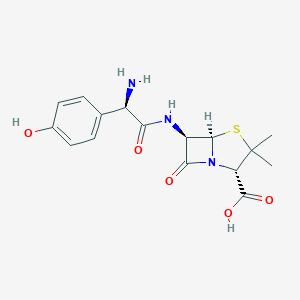
Source: National Center for Biotechnology Information. PubChem Database. Amoxicillin, CID=33613, https://pubchem.ncbi.nlm.nih.gov/compound/Amoxicillin (accessed on Jan. 20, 2020)
Store between 20-25°C. Protect from moisture and low-cal. Reconstituted oral susp: Store beneath 25°C or between ii-8°C. Do not freeze.
J01CA04 - amoxicillin ; Belongs to the class of penicillins with extended spectrum. Used in the systemic treatment of infections.
Amoxicillin 250 mg/5 mL Oral Suspension (Bristol Laboratories Ltd). MHRA. https://products.mhra.gov.u.k./. Accessed 11/06/2020.
Amoxicillin 500 mg Difficult Capsules (Kensington Pharma Ltd.). MHRA. https://products.mhra.gov.uk/. Accessed xi/06/2020.
Amoxicillin 500 mg Pulverisation for Solution for Injection or Infusion (Ibigen Srl). MHRA. https://products.mhra.gov.uk/. Accessed 11/06/2020.
Amoxicillin Capsule (West-Ward Pharmaceuticals Corp). DailyMed. Source: U.S. National Library of Medicine. https://dailymed.nlm.nih.gov/dailymed/. Accessed xi/06/2020.
Amoxicillin Tablet, Film-Coated (Aurobindo Pharma Express). DailyMed. Source: U.Southward. National Library of Medicine. https://dailymed.nlm.nih.gov/dailymed/. Accessed eleven/06/2020.
Amoxil Oral Preparations (GlaxoSmithKline Philippines Inc). MIMS Philippines. http://www.mims.com/philippines. Accessed ten/09/2020.
Anon. Amoxicillin. Lexicomp Online. Hudson, Ohio. Wolters Kluwer Clinical Drug Information, Inc. https://online.lexi.com. Accessed 11/06/2020.
Apo-Amoxi Capsules and Oral Suspension (Apotex Inc.). MIMS Singapore. http://www.mims.com/singapore. Accessed 10/09/2020.
Buckingham R (ed). Amoxicillin. Martindale: The Complete Drug Reference [online]. London. Pharmaceutical Press. https://www.medicinescomplete.com. Accessed 11/06/2020.
Cilamox Sheathing, Break (Aspen Pharma Pty Ltd). MIMS Hong Kong. http://www.mims.com/hongkong. Accessed 01/07/2020.
Douglas Pharmaceuticals Ltd. Ibiamox Pulverisation for Injection information canvass xi April 2018. Medsafe. http://www.medsafe.govt.nz/. Accessed 01/07/2020.
Articulation Formulary Committee. Amoxicillin. British National Formulary [online]. London. BMJ Group and Pharmaceutical Press. https://www.medicinescomplete.com. Accessed eleven/06/2020.
Synamox Capsules (Idaman Pharma Manufacturing Sdn Bhd). National Pharmaceutical Regulatory Agency - Ministry of Health Malaysia. https://www.npra.gov.my/. Accessed 11/06/2020.
Synamox Oral Intermission (Idaman Pharma Manufacturing Sdn Bhd). National Pharmaceutical Regulatory Agency - Ministry building of Health Malaysia. https://www.npra.gov.my/. Accessed xi/06/2020.
Source: https://www.mims.com/indonesia/drug/info/amoxicillin?mtype=generic

Post a Comment for "I Took 500mg Amoxicilling 8 Months Ago"