Funny Little Vintage Plastic Things for the End of Pencils So They Dont Roll
10 Things You Probably Did Not Know About Eraser Technology
Fact #1: Before rubber came along, people undid their mistakes using wadded-upwardly bread.
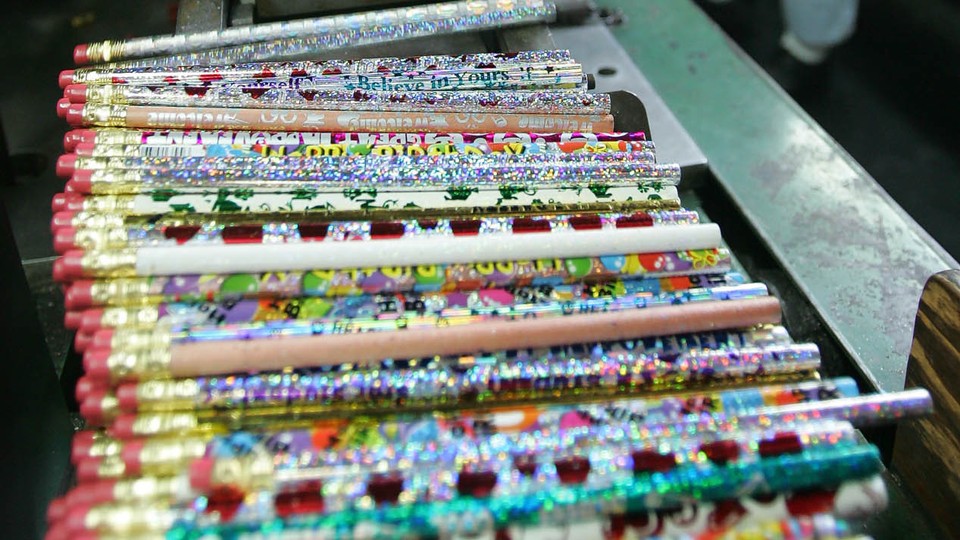
It'south true, as Arthur C. Clarke said, that the most advanced technologies are duplicate from magic. It'south not true, however, that the world's almost magical technologies are all related to computers. What could be more magic, after all, than the eraser—the niggling wad of rubber that undoes your mistakes and changes, mark by tiny footling pencil mark, homo history?
Erasers as we know them today are a relatively modern invention. But erasers as a full general category are historic period-former. The ancient Greeks and Romans relied on palimpsests and smoothable wax tablets to ensure erasability. Those gave way, somewhen, to White-Out and Photoshop'southward "magic eraser" tool and, of class, the ultimate undoer of deeds: the delete central. But erasers are far from obsolescence—only as writing itself is far from obsolescence. Below, x things to know almost erasers.
i. The original erasers were breadstuff. Moist staff of life.
Until the 1770s, humanity'south preferred way of erasing errant graphite marks relied on bread that had been de-crusted, moistened and balled up. While these erasers were cheap and plentiful, they had a singled-out disadvantage: They were, you know, made of bread. They were susceptible, similar all bread, to mold and rot. Talk virtually a kneaded eraser.
2. The same guy who discovered oxygen helped to invent erasers.
In 1770, the natural philosopher and theologian Joseph Priestley—discoverer of oxygen and, with information technology, the carbonated liquid we now know equally soda water—described "a substance excellently adjusted to the purpose of wiping from newspaper the mark of black lead pencil." The substance was rubber.
3. Erasers were invented by accident.
Though Joseph Priestly may have discovered condom's erasing properties, it'southward the British engineer Edward Nairne who is generally credited with developing and marketing the first rubber eraser in Europe. And Nairne claimed to take come upon his invention accidentally: He inadvertently picked up a piece of safe instead of breadcrumbs, he said, thereby realizing rubber's erasing properties.
4. "Rubber" actually gets its proper name from erasers.
It was Priestley who is generally credited for naming rubber. The erasing "substance" he described in 1770—initially referred to as "India glue"—required, he remarked, rubbing action on the part of the user. Thus, yep, a "safety." The name ended upwards generally applying to erasers' construction textile rather than erasers themselves, especially after Charles Goodyear figured out how to vulcanize the stuff in the mid-1800s. In Britain, erasers themselves are notwithstanding frequently chosen "rubbers." (Which may pb to some confusion, peradventure.)
five. Erasers don't just piece of work manually; they work chemically.
Pencils work because, when they are put to paper, their graphite mingles with the fiber particles that comprise the paper. And erasers work, in turn, because the polymers that make them up are stickier than the particles of paper—so graphite particles end up getting stuck to the eraser instead. They're almost like glutinous magnets.
half dozen. Pencils with built-in erasers on the tops are a largely American phenomenon.
Most pencils sold in Europe are eraser-less. Read into that cultural difference what yous volition.
7. Many erasers contain volcanic ash.
Those ubiquitous pink erasers, in particular—the pencil-toppers and Pink Pearls of the world—make use of pulverized pumice to add together abrasiveness. And pumice is, of form, volcanic ash.
eight. The little erasers on pencil ends are known as "plugs."
Aye. And those small bands of metal that contain the plugs are called "ferrules."
9. Many of today's well-nigh high-tech erasers are made of vinyl.
While the pink erasers you find on pencils are made of synthetic safety, an increasing number of erasers are made of vinyl. Vinyl's durability and flexibility give erasers made of information technology "minimal crumbling," and offer, overall, "first-class erasing performance." Plus, obviously, the sound quality is richer with vinyl.
x. There are such things as electric erasers.
Seriously. These erasers supposedly offering "a smoothen erasure with a minimum of paper trauma."
Source: https://www.theatlantic.com/technology/archive/2013/08/10-things-you-probably-did-not-know-about-eraser-technology/279028/

Post a Comment for "Funny Little Vintage Plastic Things for the End of Pencils So They Dont Roll"